Gbenekoro Village Peace Mothers Prevent School Drop-outs

This post was written by team members in Koinadugu District.

Had it not been the timely intervention of Peace Mothers in Heremakono section, Gbenekoro village, Sengbe chiefdom in Koinadugu district, two pupils of the Ahmadiyya Agricultural Secondary School and Loma Secondary School in Kabala would have dropped out of school.
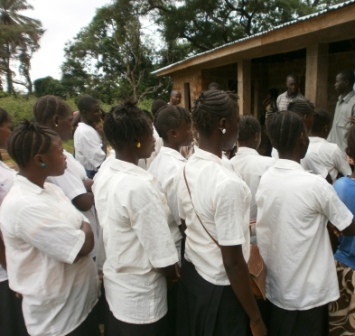
Students wait outside their school in Kabala, Koinadugu District.

Tenneh Dabo and Mariama Marah could not afford to pay school fees because their parents were killed during the war.

According to the chairlady of Peace Mothers in Gbenekoro, Pesi Mansaray, pupils, especially orphans, have been struggling to get education. She says at the beginning of every academic year, several students drop out of school because they are unable to pay school charges. She discloses that it has reached an alarming rate and is very appalling as girls that have dropped from the school system have no option but to marry against their will.

This year, the Peace Mothers decided to do something to assist children in their community. Both Tenneh and Mariama who almost dropped out of school during the peak of their external exams were rescued by Peace mothers.

How did they do that? According to Pesi Mansaray, every member of the group was asked to voluntarily contribute whatever she had. Like something pre-arranged in less than a day they were able to raise the sum of Le150,000 (35 dollars) as school fee for the two pupils.

The hope of both Tenneh and Mariama to get quality education has been restored as they continue schooling once again.

However Madam Mansaray called on humanitarian organizations to assist pupils,especially those without parents.

She says “We have started and we want to help more this year provided we  have funds from our farming activities.”

Gbenekoro is one Fambul Tok’s communities that is striving hard to be self-reliant and help push the reconciliation process ahead. The Peace Mothers’ group can now boast of some funds that they are using to do farming and to buy rice from other areas so they can sell to their community in case there is a crisis.

Saaba section rescues collaborator’s son

This post was written by Alice Musa, Field Staff Member and Contributing Blogger from Pujehun District.

Community members in Saaba section, Sowa chiefdom, Pujehun district, southern province have unanimously agreed to forgive and welcome Saffa Mambu back to their section after over 20 years.

The people of Vaawahun and Ngamayama villages in that section had harbored hatred for Saffa for a very long time because of the alleged actions of his late father, Pa Mambu, who, it was alleged, was collaborating with Revolutionary United Front rebels during the war in order to loot properties belonging to fleeing indigenes of Pujehun district.

A member of the Reconciliation team presents the kits to Mambu

The late Pa Mambu’s luck ran out during one of his looting sprees when he came into contact with the Sierra Leone Armed Forces. According to the story, Pa Mambu and two other adults were carrying property to another village and were stopped and questioned by soldiers as to where they got the goods. It was reported that the three men answered that the items belonged to them but unfortunately, Pa Mambu’s child, Saffa, who was only five years old at the time, told the soldiers that the items had been looted. Pa Mambu and the other men were executed immediately.

Saffa, a very small child,, was rescued by a man named Bassie, who was the then Civil Defence Forces commander. He was brought up in the house of Bassie, but what remained a secret was that Bassie had never disclosed to Saffa what happened during the war.

Saffa displaying his new tool kits

During Fambul Tok’s visit to Saaba section in Pujehun District, Bassie explained the full story of how he rescued Saffa from soldiers at the tender age of 5. Initially, he had some fear but after Fambul Tok’s sensitisation on the values and the need for reconciliation, Bassie was satisfied.

During a bonfire in Vaawahun village on May 17, 2013, Bassie came out and narrated the full story of Saffa and his father. The scene was emotional as Saffa himself did not know or remember anything about the death of his father and the two others.

Other testifiers also blamed Saffa’s father for their present predicaments. A good number of them in their testimonies said they have not been accomodating Saffa for what his father did during the war.

Saffa, who was very shocked and at a loss for words, said he had been finding it very difficult to come closer to his relatives. He said he did not actually understand what was going on until that night.

However, Saffa asked for forgiveness on behalf of his deceased father, which was accepted by the community. A day after the reconciliation ceremony, Saaba section in collaboration with Fambul Tok presented tool kits to Saffa as assistance to empower him in his trade as a trained and qualified carpenter. He has also vowed to help his community in his own way to achieve lasting peace and development.

Students Come Together to ‘Walk the Tok’

Libby Hoffman talks with students in Philadelphia about the Fambul Tok  school clubs program

Students around the world, after learning about Fambul Tok, have asked us how they can get involved.  Informal groups and clubs have emerged organically, some with inspiring and dedicated ways of sharing Fambul Tok’s messages of forgiveness, justice and community (notably, The Philadelphia School).  Inspired by this energy, we are developing an official Fambul Tok Student Clubs program for high schools, and will launch the pilot for this in September. The program will be action based, supporting students in learning and sharing about the values and practices of Fambul Tok, and also about what defines and makes their own communities unique.  The Clubs will help students build community at their school, and also provide a channel for connecting with students in Sierra Leone, in the process developing themselves as community and global leaders.

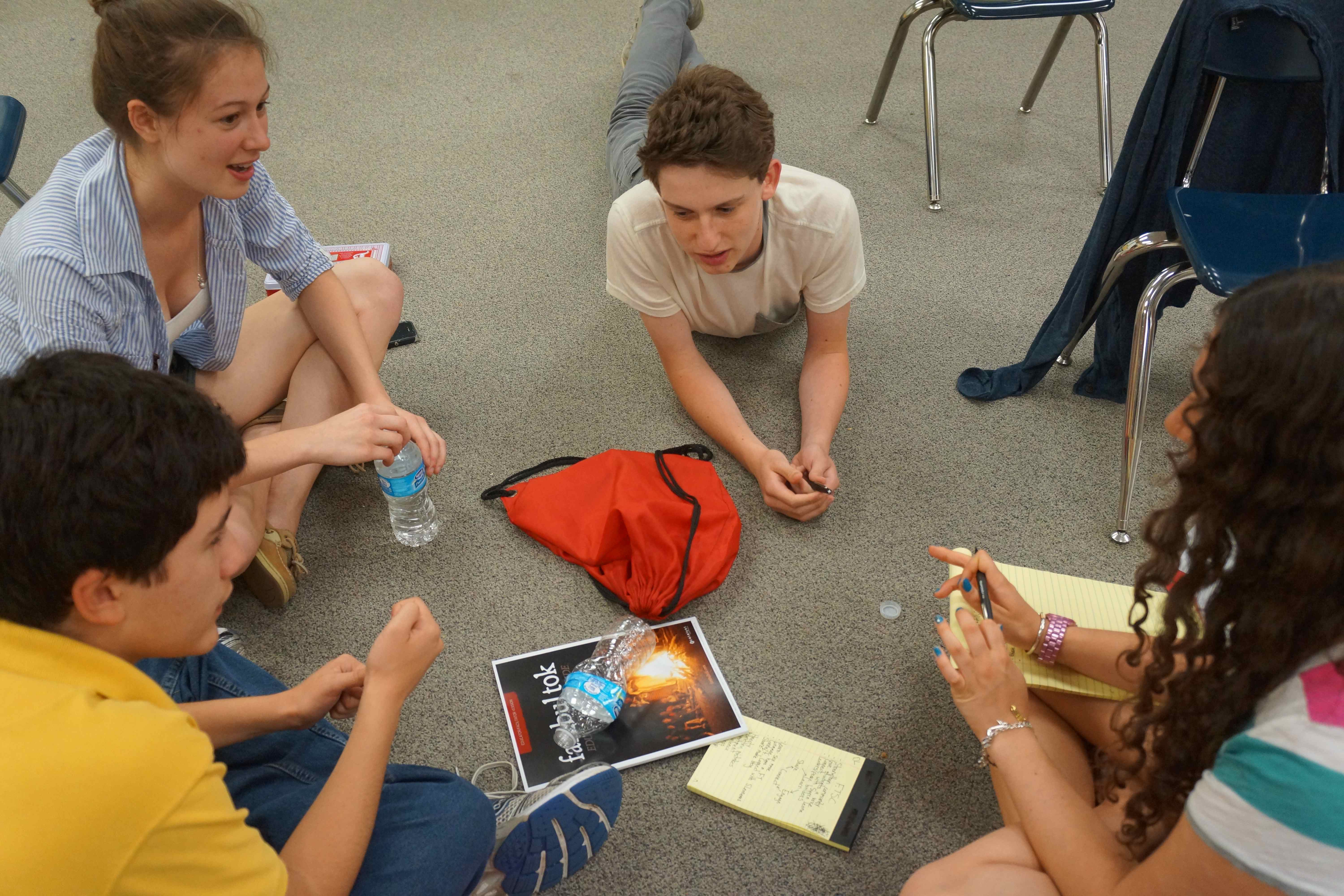
Students and parents discussing club name ideas

In keeping with Fambul Tok’s value of ‘walking with communities to find their own answers’, we wanted student involvement and ownership from the beginning of the program. On June 13th,  we held our first student consultation at The Philadelphia School, with student leaders in the area who will serve as some of our Club founders in September. The consultation had three basic goals; first to discuss the conceptual framework for the Fambul Tok Student Clubs, second to review and get feedback on a draft Club toolkit and action guide, and third, to brainstorm activities and club names.

The consultation brought together students entering seventh to tenth grade, as well as faculty and parents for an open discussion. Students were both excited and nervous about starting Fambul Tok Student Clubs and showed maturity, intelligence and passion in discussing the ideas behind the program. Their confidence grew over the course of the meeting, even as they raised and wrestled with important ‘big picture’ questions.

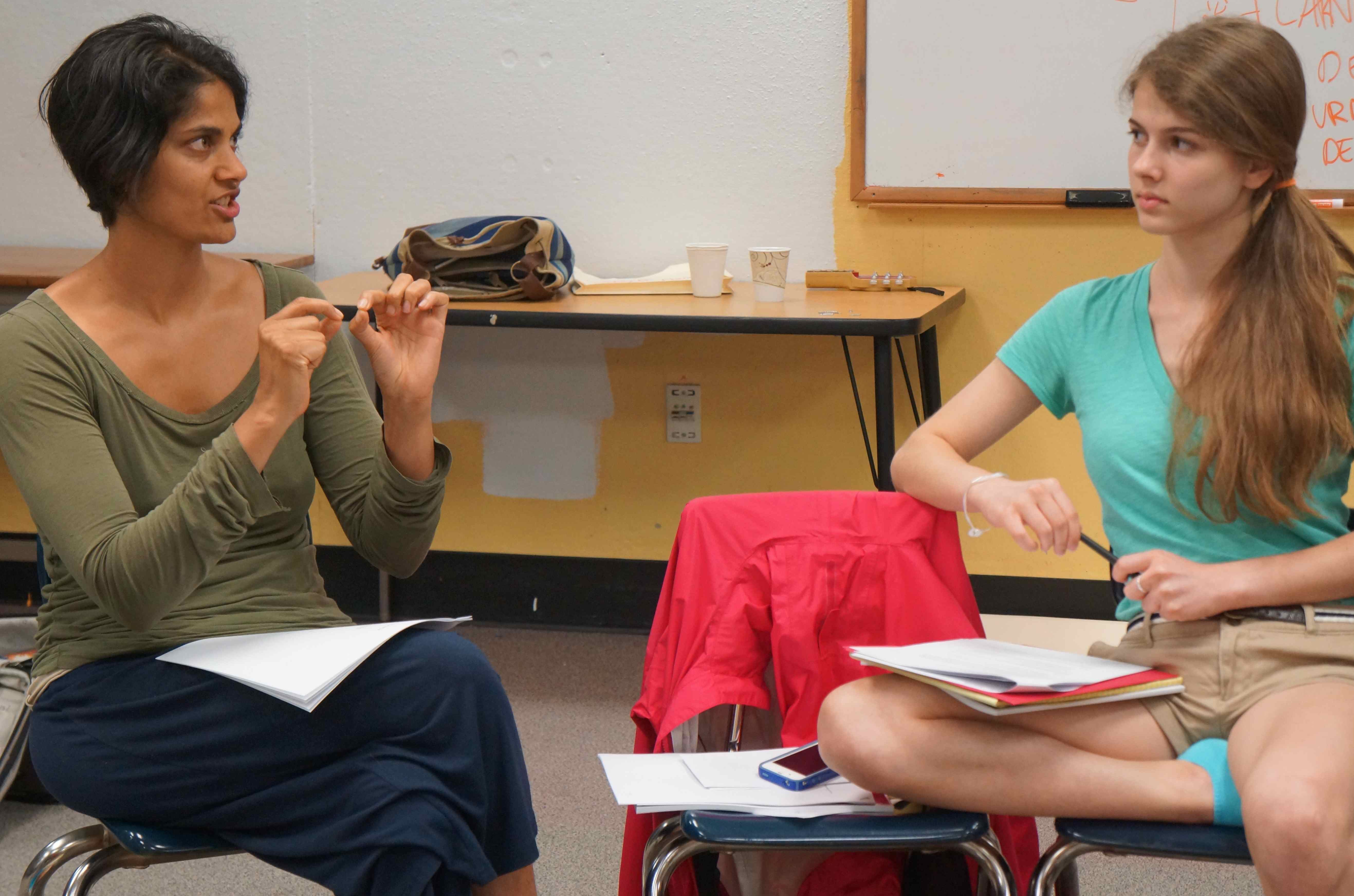
Educator Sheila Pai talking the ‘tok’

It became clear that the students’ shared common goals for the Fambul Tok Student Clubs were to use the unique and powerful teachings of Fambul Tok to create community cohesion and pride and promote student advocacy. But this raised an important question; what exactly will this look like? The ‘this’ would look different in every community and every school. Those who already know about Fambul Tok have seen how it helps in creating change, but how would students help other people understand why Fambul Tok works? Both questions remain partially unanswered, but we are sure that the answers will emerge as we continue. Fambul Tok is a concept that is both easily accessible and deeply complex. We all know why acknowledgement, apology and forgiveness help us move on, we all know how important relationships are to human existence, and we all want to be active and important members of our community. But how do we live this? How do we embody this in our individually-oriented western culture?

Students brainstorm club action ideas.

These are questions these students are clearly interested in helping to answer through action.  They are very driven to foster their own empowerment and strengthen their voice, develop strong communities, connect globally with their peers, find like-minded students, and create a safe space to talk and be with the people in their lives. Students are excited by the structure and the potential of the Fambul Tok Student Club program, always having a place to fall back on when lost, and the potential to take the Clubs in any direction they or their communities need.

Brainstorming possible club names, there was a strong interest in using the words that have come from the on-the-ground program itself.  “Wan Fambul,” which means “one family” in Krio, was a strong favorite in this regard, and “Talk the Tok” also held a lot of interest (especially since it could be shortened to T3).

Chloe Beaven presents the name ideas.

Stay tuned for more on the name as it gets finalized, and for more information on the Clubs program in the near future!

New Kailahun District Board Chairman calls for smooth transition

Board meeting in progress

The newly elected chairman of the Kailahun District Fambul Tok Board has said if Fambul Tok activities are to be sustained, every individual in the district should be ready to take ownership of the community reconciliation program.

Chief Ndolleh (r) officially hands over leadership to the new Board chairman

In his inaugural address to zonal executives and members of the new board in Kailahun Town on May 20, 2013, Paramount Chief Cyril Foray Gondor II said that Kailahun district is the first district to take ownership of the program after 5 years of Fambul Tok in that part of the country, adding that it shows that the people have understood the program and can now take manage it on their own.

He went on to stress that “Board Chairman” is just a title and has nothing to do with  the runnings of the program, adding that what is key is teamwork to ensure that every community takes full responsibility of the reconciliation activities.

“I believe in teamwork and I urge you all to work together in your different zones to make sure we contribute to the sustainance of Fambul Tok,” Chief Gondor emphasized.

He explained that “Everything we will be doing may not be 100% correct as I am certain that as we go along the line, mistakes are bound to happen. We urge Fambul Tok staff to direct and share their wonderful experiences with us throughout the transitional period.”

The Chairman was grateful to the outgoing District Executive Chairman, Maada Alpha Ndolleh, for his stewardship for the past five years. He congratulated Chief Ndolleh for supporting the reconciliation program in Kailahun and other districts and respectfully requested his continued assistance, as communities still hold him in high esteem.

Chief Gondor underscored the support Fambul Tok national staff have given and continue to give during this transitional period.

Chief Ndolleh addressing the gathering

The Vice Chairman of the Kailahun District Fambul Tok Board, Madam Satta Ndolleh, echoed Chief Gondor’s appeal and stressed that they should work together in the interest of their communities to ensure sustainable peace and tranquility prevail.

Zonal executive members further pledged their unfettered support to Kailahun District Fambul Tok, promising to play different roles toward the realization of activities in the district.

Students compose first Fambul Tok peace anthem

This post was written by Princess Deigh, Field Staff Member and Contributing Blogger from Moyamba District.

Students of the Golden Academy of Science (GAS), Mokerewa town, Fakunya chiefdom, Moyamba district, have used their talents to compose the first ever Fambul Tok peace anthem.

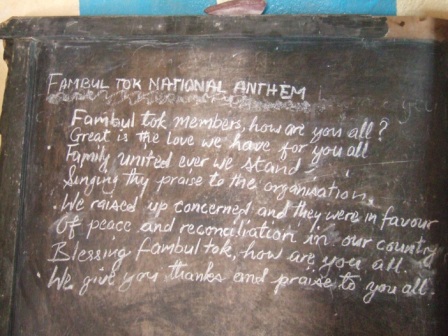
Lyrics of the Fambul Tok anthem

The lyrics to the anthem are:

Fambul Tok members, how are you all?
Great is the love we have for you all.
Family united, ever we stand
Singing thy praise to the organization.
We raised up concerned and they were in favour
Of peace and reconciliation in our country.
Blessing Fambul Tok, how are you all?
We give you thanks and praise to you all.


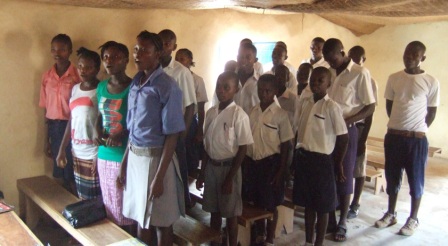
The anthem is gradually becoming popular not only among Fambul Tok school club members but also other pupils in other schools in Mokerewa town.

Explaining to Fambul Tok staff during a follow up visit in the school, President of the peace club, Julius Trye, said it was born out of the desire to promote peace and unity among students in the school. He said the club decided to compose the words to fit into the values of Fambul Tok.

Students singing the new anthem

Julius disclosed that they are very much appreciative of the efforts of Fambul Tok in promoting sustainable peace and reconciliation,adding that they will also complement the organisation’s quest to ensure that reconciliation is deeply rooted in all communities in the country.

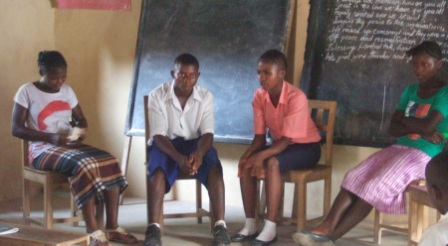
Performing a dramatic skit

The club’s Treasurer, Naomi Biayonga, called on her female colleagues to refrain from any act of violence, and help in promoting peace and reconciliation among pupils and the community. She stressed that they have been using different methods, including drama, to spread peace messages in school.

She highlighted a number of activities scheduled for June 16 (Day of the African Child), explaining that these activities gear toward teaching other pupils about Fambul Tok and how to make peace among themselves. They include football games, dance, feasting, and other celebrations and gatherings. The club also plans on performing a short play to promote Fambul Tok reconciliation practices and values.

Fambul Tok is working with two Junior Secondary Schools in each of its operational districts in the country to promote peace and reconciliation among student population.

Fambul Tok averts chaos in Jawie Chiefdom

Had it not been for the presence of Fambul Tok staff in Nyeama, one of Fambul Tok’s new sections in Jawie chiefdom, Kailahun district, the whole community would have blown up into total chaos. It all came about when local authorities brought in chiefdom police officers to arrest villagers who haven’t yet paid their local taxes. Prior to the arrest, authorities presented the names of defaulters to the police and as soon as they arrived in Nyeama village, they sprung into action.

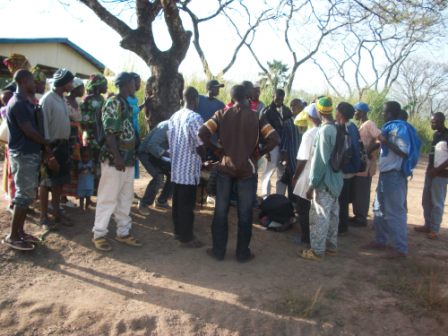
A group of youth express their frustration with police processes

Defaulters were handcuffed and locked up in dirty cells. In less than an hour, several villagers who have just returned from their farms were arrested. As the news of the arrest spread like wildfire in the village, youth numbering over 30 converged on the village centre and decided to counter the actions of the police. In just five minutes, the whole township flew into chaos as people were running all over.

Luckily, Fambul Tok staff intervened and calmed down the angry youth. One of the young men expressed disappointment in the local authorities, adding that they would have saved the situation had they (tax payers) be given prior notice. Fambul Tok staff then called on authorities to see reason and give defaulters some more time to pay up.

An agreement was reached and a grace period given to the defaulters. Fambul Tok also called on the youth to remain peaceful and not to take the law into their own hands, assuring the community that fair justice processes would prevail in the future.

Generous boost for new Peacemothers group in Pujehun

This post was written by Alice Musa, Field Staff Member and Contributing Blogger from Pujehun District.

Peace mothers in Lower Pemba, Malen chiefdom, Pujehun district have recently received a generous gesture from one of the traditional chiefs in that part of the country.

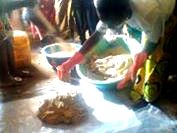
Soap-making in progress

Chief Swaray Dauda of Gadorhun village was the first individual to donated five gallons of locally-produced palm oil to the new Peacemothers group in Lower Pemba section. The reason, according to the women, was to help them embark on an inricate soap-making process.

In his address to the new group, Chief Dauda expressed a  willingness to continue to support women gearing for development in the chiefdom. He said that Fambul Tok is the first organization to bring people together in the interest of peace and reconciliation, adding that the community had not been working together since the war ended. He called on other organizations to support women’s activity in the country.

Mixing paste to mold into soap

The Chairlady of Peacemothers in the section, Fudia Moigua, expressed gratitude to Chief Dauda, calling on other philanthropists to boost women.

She explained that they have also contributed some assistance for the soap-making activity, adding that they are now producing locally made soap for sale throughout the community.

Peacemothers receive their donation from the village chief

Meanwhile, the new group, with membership from all six villages, meets every Friday and each member contributes 1,000 Leones. They also intend to embark on bread production when they have raised enough funds.

Other Peacemothers groups in the district also intend carrying out agricultural activity, modeled after the successes of Peacemothers projects throughout the country.

Peace Mothers provide educational support in Kono District

This post was written by Tamba Kamanda, Field Staff Member and Contributing Blogger from Tombodu, Kono District.

Education, they say is a key to success and Peacemothers in Kunduma village, Fiama chiefdom, Kono district are very enthusiastic to ensure that their children are exposed to quality education in that part of the country.

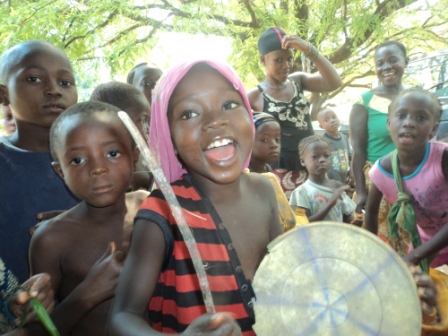
Community children celebrate Peacemothers educational contributions

After their harvest last year, Peacemothers met to decide what to do with the crops. They had 15 bags of groundnut and 25 bags of husk rice remaining, and unanimously agreed to sell part of the harvest to pay examination fees for their children who had reached Class 6 and are preparing for the National Primary School Examination in Summer 2013.

A total of ten pupils were selected without discrimination or ethnic boundary. In addition to providing each student with school fees, the women also thought it wise to buy books and other items to boost the children’s achievement. The children, in turn, were very grateful and promised to work hard to pass their examinations.

According to Sia Mani, the new Chairlady of the Peacemothers in Kunduma, women are trying very hard to help their various communities, adding that their roles were earlier restricted to the kitchens but they have proved men wrong that they can also be partners towards nation-building. She disclosed that last year, they were also able to help needy children whose parents could not afford to pay fees to go back to school. “We are doing this because Fambul Tok has assisted us a lot and it is now time to re-plow what we have to help our community,” Mani emphasized.

The only male coordinator of the Peacemothers, Sahr Yarjah, says he is happy to work with women yearning for peace and development. He recounted past years when the group started, adding that community members originally thought the formation of the Peacemothers group was a big joke. He continued to call on his colleagues to work with the group for the development of their community in particular, and the chiefdom as a whole.

One of the student recipients, Sia Komba, expressed happiness for being given support to further her education. She promised that she, along with her classmates, would not let the women down, and they would do everything possible to pass their examinations and continue to junior secondary school.

Meanwhile, Peacemothers will also continue activities they have planned for this year, including swamp rice and groundnut cultivation and their already successful fish trade.

Youth Chairman testimony shocks villagers

The youth chairman of Mawei section, Peje Bongre chiefdom, Kailahun district has taken the people of Foindu village by surprise, making a recent revelation during a bonfire on April 15, 2013.

Testifying in front of hundreds of people, Aruna explained that during the early days of the war, he was captured by marauding rebels and was ordered by one of the then commando to kill a young girl.

Fambul Tok Youth Chairman (left) apologizes for his actions during the war

According to him, he took a knife and cut the throat of the girl in front of other captives. Since he returned to Foindu, he had never had the opportunity to  tell anyone, including the father of the deceased girl, who he describes as his family friend.

After his testimony, the father, Bockarie Musa, was shocked. He was not quite sure and therefore asked the perpetrator to repeat his testimony again but Aruna apologized in tears and said it was not his fault. Other villagers were also shocked, as they did not expect that Aruna would have spoken about his deeds during the war.

What surprised most people was Bockarie’s acceptance of Aruna’s apology. Bockarie told the gathering that he did not know who killed his only daughter until that bonfire, and said Aruna is his family friend and they do things in common, despite never having revealed the truth before. The two friends, amidst sorrow, embraced each other in the spirit of reconciliation.

Importantly, Aruna also tasted the bitterness of the war in the late 90s when he was severely beaten by local militias for planting cannabi sativa (diamba). During the bonfire, he confessed and forgave those who punished him during the war. They all embraced themselves and promised to be agents of change in their communities, working together.

Apology Given for 14 People Shot Dead in the War

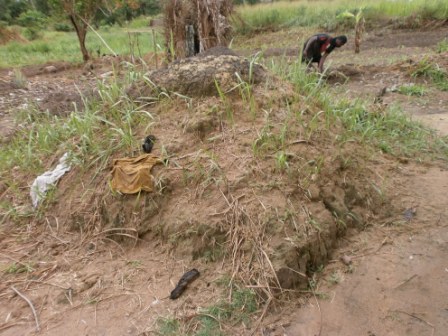
Mass grave in Bunumbu

During a Fambul Tok bonfire, in front of hundreds of villagers, one of the relatives of those shot dead told how 14 innocent people were killed by members of the Sierra Leone Army during the early days of the war in Bunumbu town, Peje West chiefdom, Kailahun district.

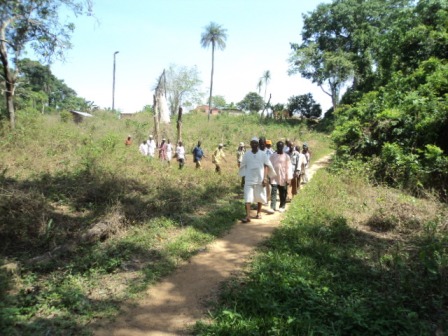
Traditional leaders walking to the ceremonial site

Testifying at a bonfire in Bunumbu town on March 29, 2013, Mohamed Bainda recalled a date in 1991 when the war raged, and several villages were captured by the then Revolutionary United Front rebels of Sierra Leone. He revealed that one of the influential figures in Bunumbu, G.G.Musa allegedly submitted names of those he thought were rebel collaborators to members of the Sierra Leone Military. He went on to state that soldiers arrested 14 people, including traditional chiefs whose names were on the list. He disclosed that without cross-checking the information, the captives were ordered to dig their own grave, and one after the other, they were shot.

Other testifiers also accused G.G. Musa of being responsible for the death of the loved ones. On behalf of the late G.G. Musa family, Henry Kamanda apologised and asked for forgiveness. He said thatt even though the accused is no longer alive, he thought it fitting to plead on his behalf.

The testimony and apology was accepted in good faith but also requested the pouring of libation  and a monument to be constructed at the mass grave site in Bunumbu.

Chief Gboso embraces his blood sister once more

Meanwhile the regent chief of Peje west chiefdom, Sheku Gboso has reconciled with his blood sister during a bonfire. Both have been alienated for the past five years but Fambul Tok made it possible for them to shake hands once again and unify as family members.