Rebel collaborator explained why he led troops

Since the war was declared over in Sierra Leone, B.K (alias ‘laugh to me’) of Madina village, Makari Gbanti chiefdom, Bombali district has been living in constant fear. His fear was that despite the end of hostilities, he was still convinced that he would be confronted by many people because of the role he played during the country’s civil war.

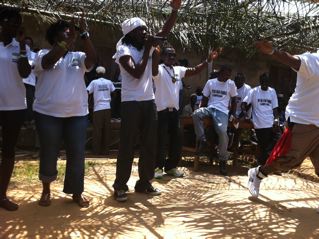
During the Fambul Tok bonfire ceremony in Madina over the weekend, B.K was accused by Ibrahim Kamara of leading gun-wielding rebels to Matoko village to loot property belonging to poor villagers.  Kamara recalled a date in 1998 when he met B.K with rebels. He said they have in their possession looted goods.

“I met him on the way and he told me he was going to see the town chief of Matoko but surprisingly when we met again, it was a different situation as gun toting men were all over the place,” Kamara explained.

Responding to the allegation, B.K carefully narrated his ordeal with the rebels. He said he was captured against his will and forced to lead troops to loot items in nearby villages.

“You all know that during that time people were forced to do things and had I refused I would have been killed,” B.K told his audience.

The two men shook hands after the involvement of Fambul Tok reconciliation committee members that prevailed on both men to see themselves as brothers once again and turn a new page.

Fambul Tok Wins Best of the Fest at the Global Social Change Film Festival in Bali

Opening Night at the Global Social Film Festival in BaliFambul Tok opened the first annual Global Social Change Film Festival in Bali on April 13, 2011, and was awarded Best of the Fest at the film festival’s conclusion. As GSCFF is also committed to supporting social activism through storytelling, this award is particularly meaningful for Fambul Tok.

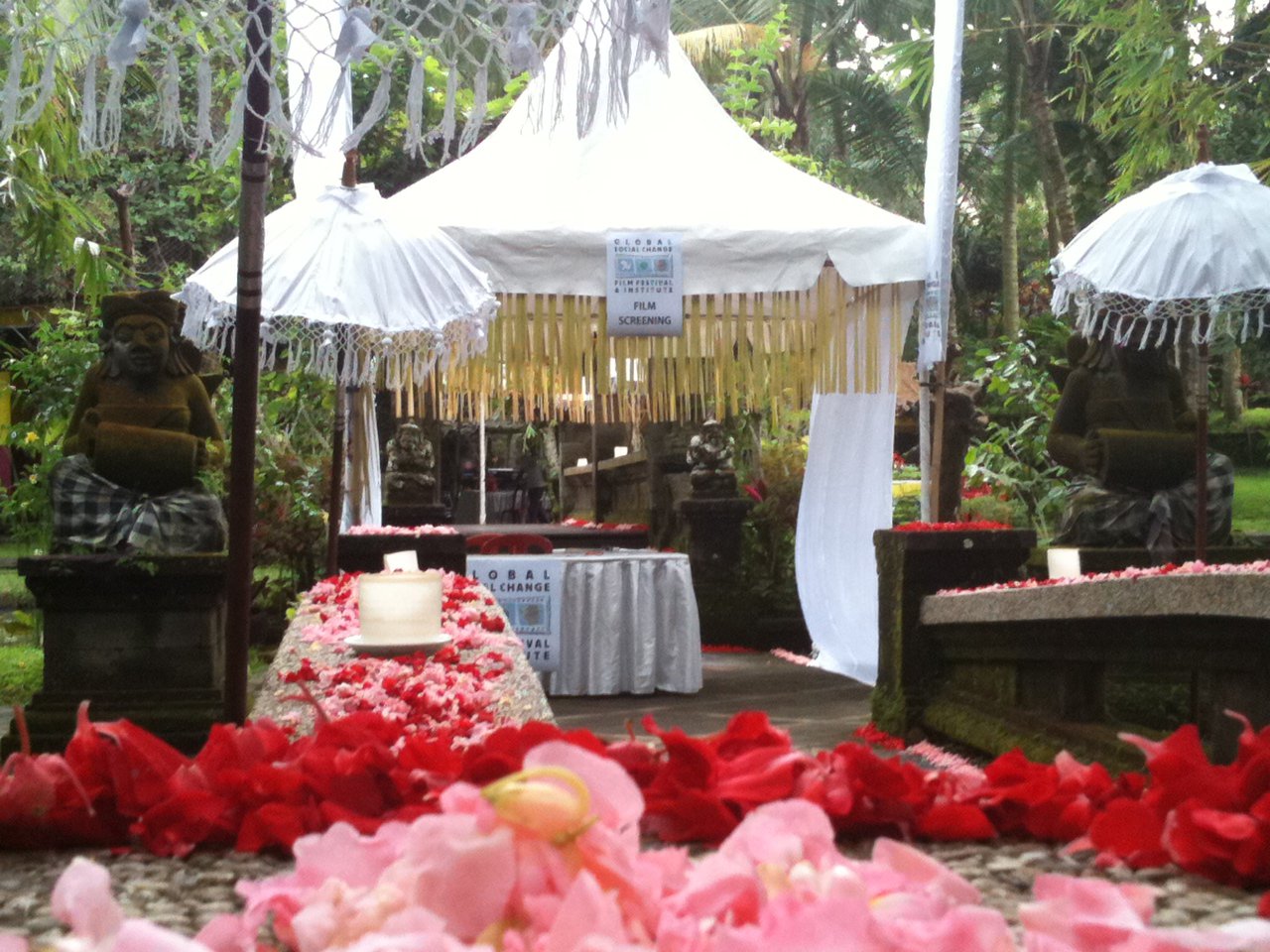
And the festival itself was an extraordinary experience. Guests arrived at Fambul Tok’s screening on opening night through a canopy of flowers and across a carpet of petals. As producer and director Sara Terry observed, “who needs a red carpet?”

To read more about opening night, visit the GSCFF blog. To learn more about this important film festival, visit the GSCFF website.

Notes from Nashville – Fambul Tok Named 2011 NPT Human Spirit Award Winner at the Nashville Film Festival

Nashville Public Television (NPT) chose Fambul Tok as the 2011 recipient of the NPT Human Spirit Award at the Nashville Film Festival. The award is presented each year to a documentary selection and applauds the filmmaker’s ability to convey the generosity, kindness, mercy and compassion of the human spirit. The award will be presented to Director/Producer Sara Terry prior to the film’s second screening at the Nashville Film Festival, Monday, April 18 at 5:15 pm, screening at Regal Green Hills Cinema.

“The capacity for forgiveness and reconciliation is intrinsic to the human spirit,” reads the NPT jury statement. (Fambul Tok International founder) John Caulker is the embodiment of the power of embracing that spirit for the betterment of humankind, and in turn, our compass. He is accomplishing what hundreds of millions of dollars could not.

“The compassion of the people of Sierra Leone and their desire to rebuild there lives and country is captured by Sara Terry with a combination of honesty, rawness and beauty that is rare. She has given us stories of people, then and now, and asked to look within ourselves to discover our own capacity for forgiveness and reconciliation. The result is transformative.”

To read more about the award and the NPT jury’s reaction to Fambul Tok, visit the NPT blog.

African premiere of Fambul Tok (the film)

On the evening of March 22, hundreds of people swarmed the town of Bomaru, a small town in the eastern corner of Sierra Leone, near the Liberian border.  They came from all over the district (Kailahun), and indeed all over the country, to watch the African premiere of Fambul Tok. They came on motorcycles, cars, buses and flatbed trucks – whatever vehicles the Fambul Tok staff could rustle up – and on foot from neighboring communities, delaying the start time for the screening till after 10 pm to allow for everyone to arrive.

Even the children were eager to gather to watch the film in Bomaru

Finally, under a starry sky (the threatening gray clouds had blown over), in a town clearing with chairs and benches packed to capacity and folks seated on the ground or crowds standing on the edges all around, the film began, the significance of the moment apparent to all.

20 years ago exactly, the first rebels had crossed into Bomaru from Liberia to fire the shots that began the 11-year civil war.  Exactly 3 years before, the very spot that now held benches and chairs had been the site of the first Fambul Tok reconciliation bonfire, officially launching the tradition-based community healing process that the documentary film is now helping to share with the world.  The screening on this night marked the first time the people of Kailahun district were seeing their stories, their process, on film.

That the screening in Bomaru was completely different from the film’s US premieres at SXSW in Austin hardly needs noting. Besides the bugs crawling across the screen and the persistent low hum of the generator, or other accompaniments of an outdoor setting like this, there was a constant buzz of conversation throughout the film.  Part of it was people translating the Kono, or Kisse, or English, for their friends who spoke only Mende or Krio.  Part of it was the constant, verbal response to the stories they were witnessing on the screen – whether it was the wrenching scenes of people’s testimonies about what happened to them, or what they did, during the war, or the awe-inspiring expressions of apology and forgiveness that they were seeing on screen for the first time.  In Africa, a film is not something to be experienced quietly I learned – especially one like this.

Sobered by the stories, and the memories they evoked, after the screening there was an opportunity to move into celebrating the hard-won reconciliation that the communities of Kailahun have been working so hard to achieve over the last 3 years.  Renowned musicians Bajah and the Dry Eye Crew, Lady P, and Angie took to the stage for a rousing concert, climaxing with their performance of the new national unity campaign theme song, Wi Na Wan Fambul (We are one family).

Bajah and the Dry Eye Crew perform after the premiere in Bomaru

Sahr and Nyumah, whose story is featured early in the film, were there.  The morning after the screening they described their surprise at the comments they were getting – they laughed at being recognized as “stars,” and were slightly wide eyed at the realization that their powerful story of reconciliation was now inspiring others to take courageous steps toward apology and forgiveness.  They realized with pride that they were now teachers for others.

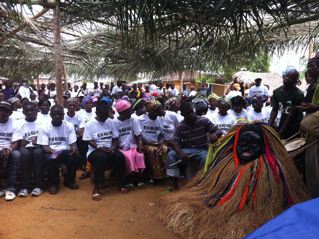
crowds gather in Bomaru for launch of Wi Na Wan Fambul campaign

How Sierra Leoneans and their culture were teachers for the world was a theme of the official Wi Na Wan Fambul Campaign Launch the next morning.  Calling for March 23rd to be recognized as a national day of remembrance, Fambul Tok International led a coalition of other civil society groups – including Campaign for Good Governance, Search for Common Ground, and CCYA – in launching the 2-year long campaign, designed to have Sierra Leoneans stories of reconciliation inspire a stranger sense of national unity and support a violence-free national election in 2012.  The campaign will center around screening the film in villages across the country, followed by community dialogues on the issues it raises.
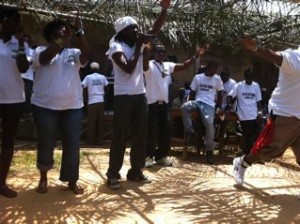
Bajah, Lady P and Angie sing for peace

Boroma:The fish trade boom

harvesting peacemothers farm in MoyambaFambul Tok peace mothers in Kailahun, Kono, Moyamba and Koinadugu districts all give testimonies of bumper harvests of their farms this year. As Fambul Tok walks alongside these groups, they have started realizing more and more of their potential, planning larger farms and using their savings for more income generating projects like starting markets.
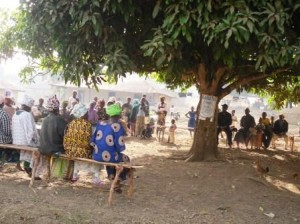
In Mye section, Timidale chiefdom, Moyamba district, the women’s support group (Peace  others) harvested 11 bags of groundnuts (peanuts) from just three bushels planted. Great harvest indeed! Other communities in Moyamba are harvesting rice farms and intend on cultivating more land against next planting season.

The women of Kailahun, a district dubbed to now have “extra” of everything, continues to set the pace of admiration from neighboring Liberia and Guinea.

Koinadugu district, which recently formed the Peace Mothers groups has earlier begun work immediately after the reconciliation ceremonies.

One of the communities that has demonstrated women can do even better than men is Boroma in the Gbense chiefdom, Kono district. Fambul Tok women in Boroma did not wait for anyone to give them the go ahead so immediately after their ceremonies they asked traditional leaders for a piece of land that was offered to them, to plant a farm. Work kicked off with their  little resources. They faced challenges but that did not stop them from carrying out their purpose.

They had no machetes of theirs  they used to borrow. Guess what, during work hours the items were taken from them. When Fambul Tok came to their aid, they all agreed to use the money judiciously. A carton of fish was bought and shared among them to sell. As the proceeds increased, another carton was added to boom the trade. Today, with their profits, they have decided to build a multi-purpose store in the dry season.

Speaking to the chairlady of the group, she said despite challenges, they planted beans. Sia Korbia went on to state that they have agreed to construct a building to store their harvest. She called on others not to relent but to work as a team to develop themselves.

Meanwhile, Boroma has decided to open a savings account so that they can save enough money to start other projects.

Ex-commander turns Pastor

A former rebel commando of the Revolutionary United Front (RUF) has chosen a new path to life, transforming from a once dreaded gun-wielding fighter to a born again christian and eventually a Pastor in his village.

In his testimony during the Fambul Tok reconciliation ceremony in Nyadehun village, Luawa chiefdom, Kailahun district, Mattia,whose bush name was ‘Commando Agama’, said he regretted joining the the then fighting forces. He narrated how he was captured by RUF rebels and due to threats of being executed should he attempt to escape, he decided to stay with the movement.

Pastor Mattia, as he is now known, apologized to all those he had wronged during the war. He said since he returned to Nyadehun village after the war, he has continued to work with his people to develop the area and its environment.

‘We are working together as brothers and sisters; the only problem was that I did not have the opportunity to apologize to my people for what went wrong but since Fambul Tok has created that space, I want to use this opportunity to say sorry and ask for forgiveness,” he appealed to his audience.

One of the victims that accused Mattia, said even though he lost his brother during the war, he is still willing to forgive Mattia.

Fambul Tok reconciliation committee brought Mattia and Lahai Jusu together to reconcile.

Heremakono begins savings program

Meeting in Heremano village

Meeting in Heremano village

Heremakono section, in the Wara Wara Yagala chiefdom in Koinadugu district, in the north of Sierra Leone has been passed by over and over by aid organizations helping neighboring communities.  The section, which is situated along the Makeni-Kabala  highway has only four villages, and is just about 3km to the district headquarter town of Kabala.  It is common for communities close to cities and located along highways to be left out, as aid organizations assume they can handle issues themselves and focus on more remote areas.

In November, 2010, Fambul Tok entered Heremakono section. After a stakeholders’ meeting, training and sensitisation, the community held its traditional ceremonies. During sensitisation sessions, many villagers said their section is underdeveloped and said no organisation has come to their aid.

Just two months after their ceremonies, a local non-governmental organisation-FUTURE IN YOUR HANDS for the very first time convened a meeting with Heremakono community and has started its savings project (Osusu).

During a visit to Heremakano, chairlady of the women, Madam Mbalia Koroma  said since their traditional ceremonies, which brought them together in unity, their situation has changed

“We are now proud of making savings from our little earnings. This is the fact that we have forgiven ourselves and now work as one family. If Fambul Tok did not bring us together it would have been very difficult for the NGO to work with us.  I think our ancestors have accepted us once again,” Koroma disclosed.

The section chief, Pa Koroma, testified that things are better now as compared to last year. He said they used to have lots of problems with cattle rearers but that these have minimised after Fambul Tok ceremonies.

The women of the section have decided to form the women’s support groups (peace mothers) at the end of January. They also said they plan to do vegetable gardening in the dry season.